What Changes in the GHG Protocol: The Three Statements That Will Separate Emissions, Market, and Impact
The GHG Protocol proposed a new reporting framework with three distinct statements. Understand what changes for companies measuring emissions and purchasing carbon credits.

On July 29, 2026, the GHG Protocol announced a landmark package of updates to its corporate accounting standards. Among them, the most consequential proposal for organizations measuring emissions and acquiring carbon credits is the Actions and Market Instruments (AMI) standard: rather than reporting a single net figure, companies would report three separate, dedicated statements. While still in development, the proposal clearly signals the regulatory direction corporate climate reporting will take over the coming years.
The underlying logic is straightforward. The first statement remains dedicated to gross physical emissions: how much greenhouse gas the company actually emitted through its operations and supply chain across Scopes 1, 2, and 3. The second statement records market-based contractual instruments, such as renewable energy certificates and contractual mitigation claims. The third, and most innovative, measures the real-world climate impact of actions and corporate investments, calculated through counterfactual methods assessing what emissions would have occurred in the absence of that intervention. Crucially, a carbon credit does not subtract from the first statement as an internal discount; it is reported transparently on its own merit.
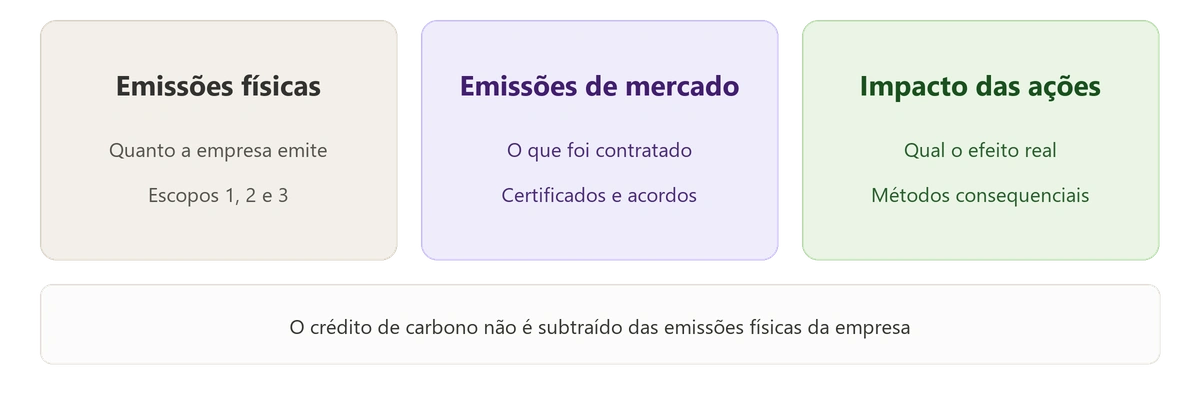
This accounting separation significantly raises the bar on credit quality. When disclosure evaluates the tangible effect of an intervention, scrutiny focuses directly on project baseline integrity, additionality, leakage risk, and long-term permanence of conserved biomass. In practice, credits supported by flimsy documentation lose market value rapidly, while projects built on rigorous methodologies and verifiable traceability gain premium demand. The framework also reinforces what has always been foundational to sound climate strategy: reduce direct operational emissions first, then compensate residual emissions that cannot yet be eliminated.
The announcement included two additional strategic updates for corporate planning. The GHG Protocol and ISO will harmonize their corporate standards into a unified global framework, aligning Scopes 1, 2, and 3 and the AMI standard with ISO 14064-1, with a public consultation scheduled for Q2 2027. Meanwhile, the consultation on Scope 2 guidance, which gathered nearly 1,100 responses from 56 countries, remains under review across multiple dual-reporting models. The practical recommendation for sustainability leaders today is to maintain dual Scope 2 reporting (location-based and market-based) and proceed with inventory structuring without delay. A well-built inventory will maintain full compliance and seamlessly integrate into the harmonized standard upon publication.
Canopée structures corporate GHG inventories aligned with the GHG Protocol and closely follows standards governance, as these rules determine how corporate climate commitments are verified globally. This clear demarcation between gross operational footprint and external financing aligns with our foundational philosophy: avoided emissions are not the same as a tradable carbon credit, and offsetting does not replace emissions reductions. Our forest projects in Acre adhere to this discipline end-to-end. The Yuxibu project is certified by Bureau Veritas with Solana blockchain registration. Yuxibu 2 and Itxawá are certified by Cercarbono under methodology M/LU-REDD+ v3.1 and registered on EcoRegistry, a distributed ledger platform engineered for transparency, security, and traceability in environmental assets. Each tonne can be audited back to source—precisely the high-integrity proof modern reporting mandates. If your company is structuring its inventory or assessing carbon credits against these requirements, get in touch with us.