The Role of the Carbon Market in the Climate Transition
How market-based instruments and technological innovation accelerate the transition toward a low-carbon economy while protecting tropical ecosystems.

The global climate is changing at an unprecedented pace, mobilizing scientists, governments, and corporations worldwide. Rising greenhouse gas emissions, particularly carbon dioxide (CO₂), correlate directly with intensifying extreme weather phenomena, including historic droughts, floods, and heatwaves. Addressing this challenge requires not only rapid clean-tech deployment, but also robust economic instruments that internalize environmental externalities and accelerate capital reallocation.
The carbon market serves as one of the most powerful instruments available. By assigning a financial cost to emissions, it establishes clear monetary incentives for organizations to curb their environmental footprint and invest in sustainable operational alternatives, pricing an impact that was historically externalized onto society.
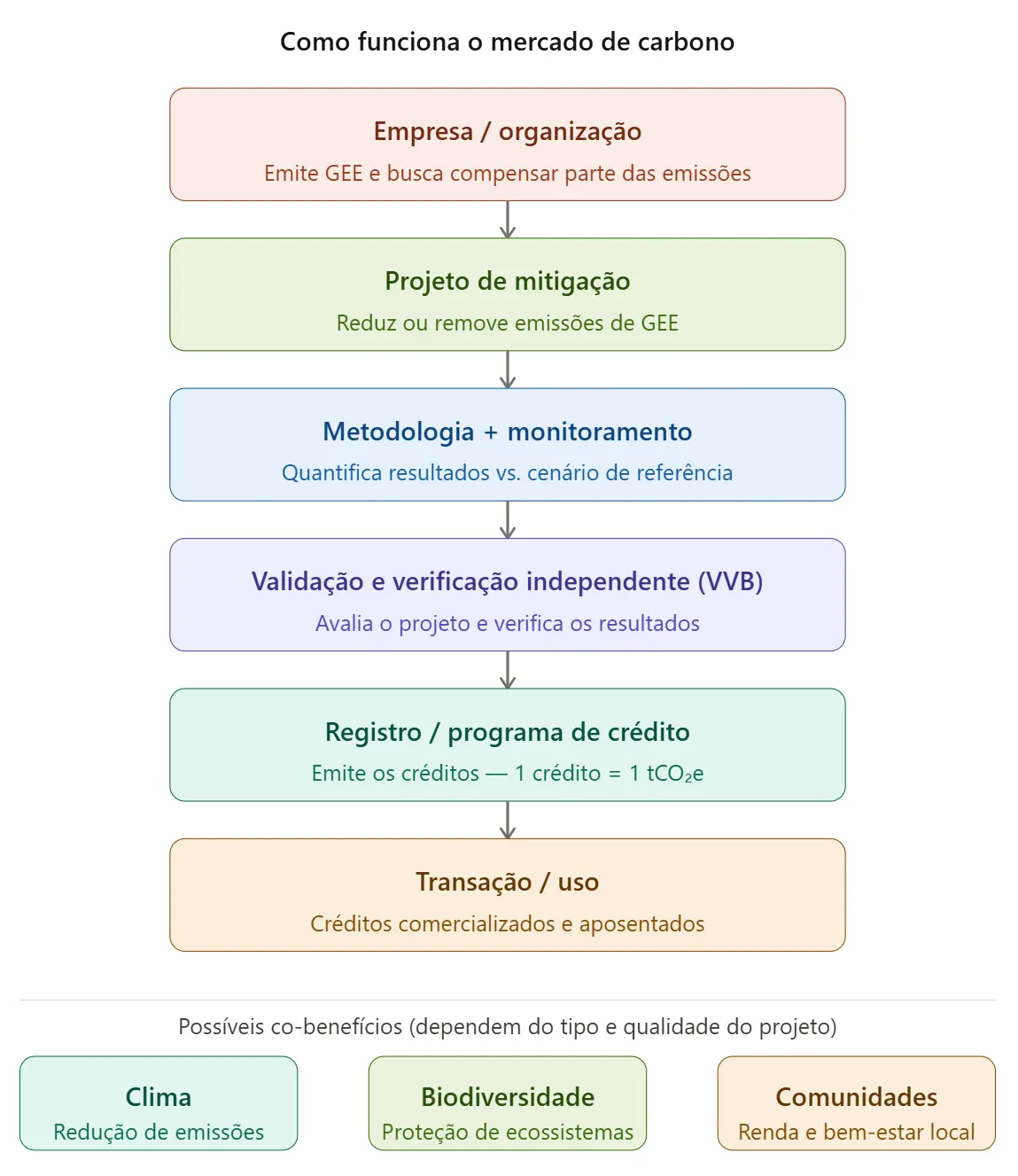
One carbon credit represents one tonne of CO₂ equivalent (tCO₂e) reduced, avoided, or removed from the atmosphere, measured against an established baseline. For credits to deliver legitimate impact, they must satisfy rigorous additionality criteria, conservative MRV auditing, and permanent tracking on official digital registries to prevent double claiming.
These credits originate from diverse mitigation activities—ranging from tropical forest conservation and native ecosystem restoration to renewable energy and industrial efficiency. Globally, trading operates across two primary frameworks:
- Regulated: with mandatory targets defined by governments;
- Voluntary: adopted by companies as part of their climate strategies and ESG commitments.
Despite its rapid expansion, the carbon market never replaces direct operational decarbonization. The absolute corporate priority must remain emissions avoidance and operational reduction. Carbon credits serve as an essential complementary instrument, targeted at neutralizing residual emissions and directing private capital to nature-based solutions that would otherwise lack conservation funding.
Brazil occupies a strategic position in this scenario. With vast natural assets and great potential in nature-based solutions—such as REDD+ projects—the country can generate high-quality environmental assets. Advances in the national regulatory framework tend to strengthen this market, providing greater legal certainty and attracting investments.
For organizations, the climate roadmap begins with compiling a greenhouse gas inventory under the GHG Protocol. Grounded in this diagnosis, leaders establish science-based reduction targets and integrate verified carbon credits into a resilient climate strategy.
Far from a transient corporate trend, participating in carbon markets with verified integrity has become an enduring competitive advantage, demanded by discerning investors, commercial supply chains, and consumers evaluating genuine environmental action.
Canopée supports organizations across every phase of this climate roadmap, from emissions diagnostics to sourcing and managing verified REDD+ carbon credits. Contact our team to explore how we can support your organization's climate transition.