SBCE Sectoral Coverage: How to Know If Your Company Enters the First Phase
Understand the inclusion criteria in the SBCE and what to do now to prepare your company.
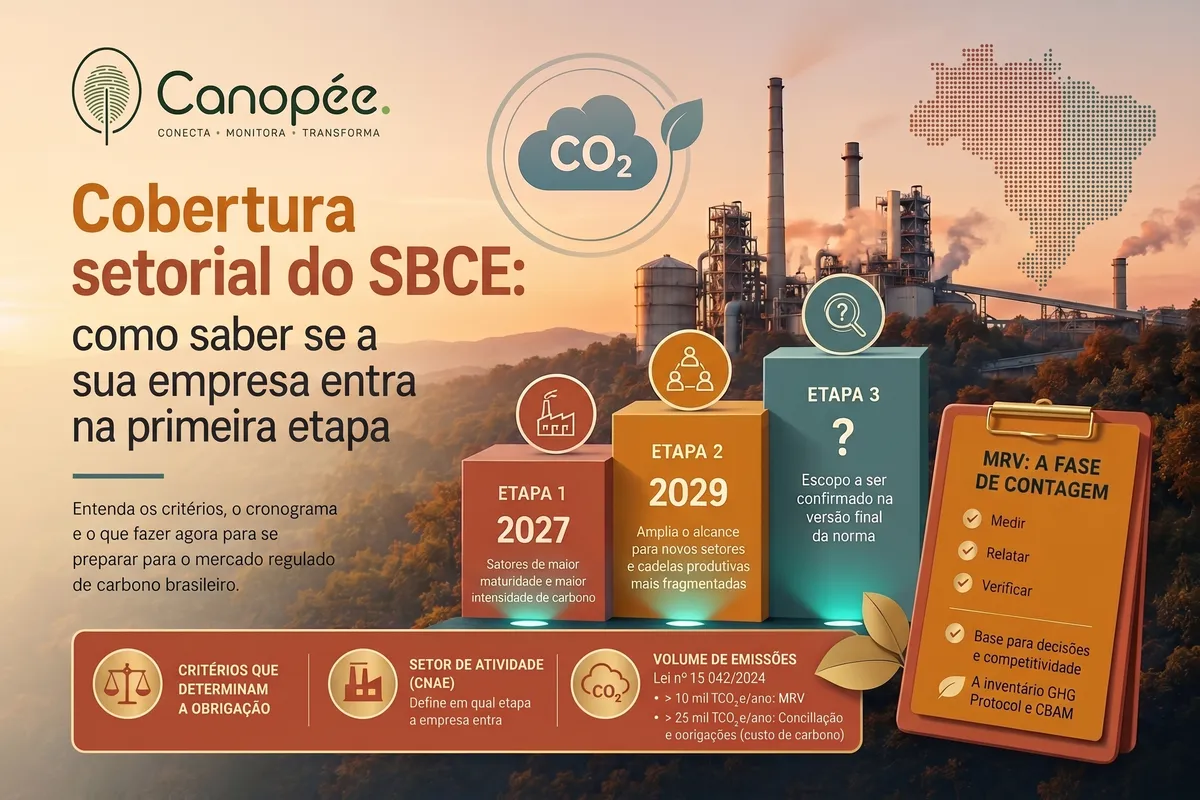
On July 28, 2026, the Extraordinary Secretariat for the Carbon Market (SEMC) of the Ministry of Finance opened Public Consultation No. 1/2026 on the draft Ordinance defining the sectoral coverage of the Brazilian Emissions Trading System (SBCE). The consultation remained open until August 28, and the final version of the regulation is expected to be published later in 2026. In practice, this is the document that answers the question many companies have been postponing: when does my operation become legally required to measure and report its emissions? Until now, the SBCE was a framework law, but with this Ordinance, it becomes an agenda with fixed calendar dates.
Inclusion Criteria
Inclusion depends on two criteria that work together. The first is the sector of activity, identified by the National Classification of Economic Activities (CNAE) codes listed in the annexes of the draft, which defines which phase the company enters. The second is emissions volume, already established by Law No. 15,042/2024: operators of installations and sources emitting more than 10,000 tonnes of CO2 equivalent per year must submit a monitoring plan and annual report of emissions and removals; those emitting above 25,000 tonnes per year are also subject to periodic reconciliation of obligations—the stage where the cost of carbon actually hits the balance sheet. In other words, being in the covered sector is not enough, and emitting heavily is not enough either; it is the combination of both that brings a company into the regulated system.
The Proposed Timeline
The proposed timeline organizes entry into three successive phases, allowing different adaptation windows according to each industry profile. The first phase, starting in 2027, focuses on sectors with higher measurement maturity and greater carbon intensity per unit produced. The second phase, scheduled for 2029, expands coverage significantly to include sectors with more fragmented supply chains. The third phase is outlined in the proposal, with its definitive scope to be confirmed in the final version of the standard.
MRV: The Measurement Phase
Here lies the most common misunderstanding of the moment, and it is worth clearing it up directly. Entering the MRV (Monitoring, Reporting, and Verification) list does not mean buying allowances or paying for carbon immediately. The Ministry of Finance itself noted that including a sector in monitoring obligations does not imply immediate submission to emission caps or surrender obligations. The emissions cap, allocation rules for Brazilian Emissions Allowances (CBEs), and criteria for using Verified Emission Reduction or Removal Certificates (CRVEs) will be established in subsequent regulations. MRV is the counting phase, and it exists precisely because governments cannot allocate allowances against a data baseline that nobody has verified.
What Companies Should Do Now
What this requires from companies right now is less dramatic and more operational than it might seem: verify the alignment of corporate activities with the CNAE codes in the annexes, estimate annual emissions volume per facility to identify which side of the 10,000 and 25,000-tonne thresholds operations sit on, and begin structuring an auditable greenhouse gas inventory. The draft provides a minimum notice of 120 calendar days for regulatory acts detailing each phase, leaving a narrow window for companies entering in 2027. Furthermore, the same inventory built under the GHG Protocol serves as the foundation for the SBCE, for CBAM reporting on European exports, and for investor disclosure demands, transforming compliance overhead into a single, reusable information asset. At Canopée, this is precisely the structured starting point we establish with our clients.