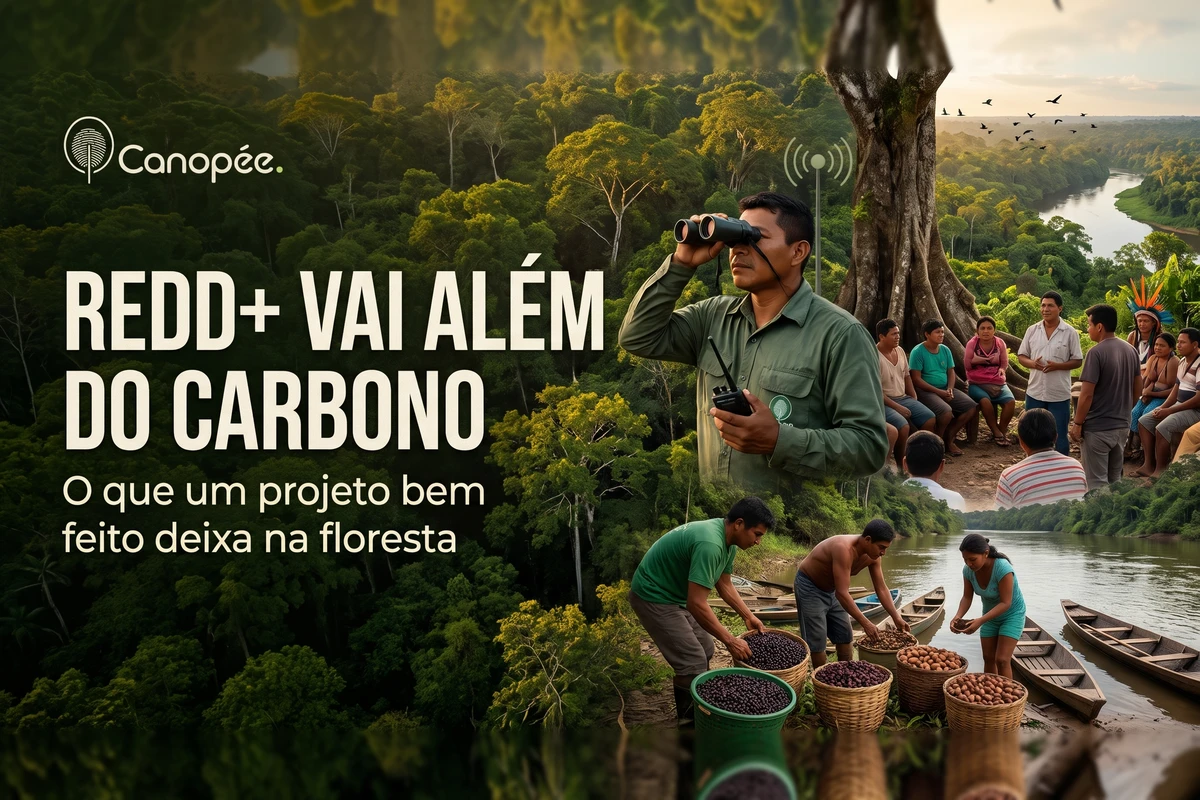
REDD+ Beyond Carbon: What a Well-Designed Project Leaves in the Forest
Tonnes of CO2 measure the outcome, but it is on-the-ground work that keeps the forest standing for decades.
When discussing forest carbon credits, the conversation almost always revolves around a single figure: how many tonnes of CO2 were prevented from being emitted. That number matters a great deal, as it becomes the credit, is audited, and reaches the buyer.
However, it tells only half the story. A forest does not remain standing merely because there is a carbon target associated with it. It remains standing because someone is watching over it, because local communities have a voice in decision-making, and because keeping the forest alive is economically more viable than clearing it. In this article, we explain what a well-structured REDD+ project delivers beyond carbon and why this also safeguards credit quality.
What is REDD+, in brief
REDD+ stands for Reducing Emissions from Deforestation and Forest Degradation. The premise is straightforward: when an area of threatened forest is protected from clearing, the carbon stored within the trees is not released into the atmosphere. This avoided emission is measured, verified by an independent audit, and converted into carbon credits.
The "+" in the acronym signifies that the mechanism goes beyond halting deforestation; it encompasses conservation, sustainable forest management, and the enhancement of forest carbon stocks. International REDD+ rules also mandate social and environmental safeguards: respect for the rights of Indigenous peoples and local communities, stakeholder participation in decisions, and biodiversity protection.
In summary, the credit is the metric. The protected forest, along with the people who inhabit it, is the true outcome.
Four benefits not captured in the tonnage calculation
1. Constant territorial surveillance
Extensive tracts of forest require continuous monitoring. Road building, unauthorized incursions, fire outbreaks, illegal mining, and unauthorized logging typically start on a small scale. A portion of REDD+ project revenue can fund satellite imagery, technical equipment, and trained local response teams.
Satellites detect where forest cover has changed. The ground team understands what is happening and knows how to intervene. It is this combination that transforms monitoring into genuine protection.
2. Engaged communities
Forest projects take place in territories that already have inhabitants, organizations, and established governance structures. A pivotal question in any credible project is: who decides how resources are allocated?
When priorities are determined through assemblies, associations, and local leadership, the project strengthens these civic institutions. They gain capacity to plan, manage budgets, and ensure accountability—capabilities that endure long after the credit crediting cycle concludes.
3. Income rooted in a standing forest
In the Amazon, açaí, Brazil nuts, natural oils, seeds, and native fruits can sustain entire economic value chains. However, supporting these value chains requires far more than financing harvesting; it demands investment in processing, storage facilities, logistics, cooperative governance, and market access.
When these investments occur, the economic rationale shifts: the forest ceases to be viewed as land awaiting conversion and becomes the foundation of a viable bioeconomy. It is important to note that deforestation stems from complex drivers, including commodity price dynamics, irregular land occupation, and institutional vulnerabilities. Local income is therefore a vital part of the solution, not the entirety of it.
4. Protection beyond the project boundary
Every REDD+ project faces an inherent risk: leakage. If deforestation is prevented within the project perimeter but simply shifts to adjacent lands, part of the atmospheric climate benefit is compromised.
Projects that also invest in the surrounding landscape—providing agricultural extension services to neighboring landholders, restoring degraded pastures, and creating alternative livelihoods—tackle the underlying drivers that could displace deforestation outside the protected boundary. Here, social benefits and climate integrity work hand in hand.
Co-benefits add value, but do not replace integrity
All of these factors reinforce a project, but they do not automatically certify that the credit is robust. A high-quality REDD+ credit must continue to substantiate key technical criteria verified through independent third-party audits:
- Additionality: the avoided deforestation would not have occurred in the absence of the project.
- Robust baseline: a credible, scientifically backed projection of deforestation that would have taken place without intervention.
- Accounted leakage: the risk of deforestation displacing beyond the project perimeter is quantified and deducted.
- Uncertainty management: margins of measurement error are conservatively factored into final calculations.
- Independent verification: an accredited certification standard inspects the results before any credit is issued.
The optimal outcome occurs when both dimensions reinforce each other: technical rigor guarantees that the carbon tonne is genuine, and on-the-ground engagement ensures that it remains real for decades to come.
How Canopée applies this approach
At Canopée Ambiental, we view carbon credits as the consequence of a well-protected forest, never the reverse. Our REDD+ projects—Yuxibu, Yuxibu 2, and Itxawá—have undergone rigorous independent certification by Bureau Veritas (Yuxibu) and Cercarbono (Itxawá and Yuxibu 2), assessing both avoided emissions modeling and social and environmental safeguards.
For corporate buyers, this represents far more than offsetting greenhouse gas emissions. It means supporting a territory that builds the autonomy to protect itself over time, delivering verifiable outcomes that can be communicated with confidence.
Want to understand how REDD+ credits can support your company's climate strategy? Speak with the Canopée team.