How Carbon Credits Are Verified: Standards, Additionality, and Risks
Understand how carbon credits undergo MRV auditing, how additionality is proven, and how risk mitigation mechanisms protect market integrity.

The core proposition of the carbon market is clear: channel financial capital toward activities that measurably reduce or remove greenhouse gas emissions. For this mechanism to be credible, every issued credit must represent one tonne of CO₂ equivalent quantified on rigorous scientific foundations, governed by transparent rules, and validated through independent third-party audits.
This verification process is governed by international standards and technical protocols comprising MRV—Measurement, Reporting, and Verification—the foundation of integrity in the voluntary carbon market. A central and frequently debated concept is additionality. A project is deemed additional when its greenhouse gas reductions or removals would not have occurred without the financial incentive provided by carbon credit revenues. This assessment extends beyond financial viability, evaluating regulatory requirements, technological hurdles, and common practice within the geographic jurisdiction where the project operates.
Verifying additionality depends on defining a baseline scenario representing plausible emissions in the absence of the project. This baseline is constructed using historical data, regional benchmarks, and methodologies approved by certification standards. Because it models a forward-looking projection, it involves inherent uncertainties, making well-founded assumptions and independent validation essential.
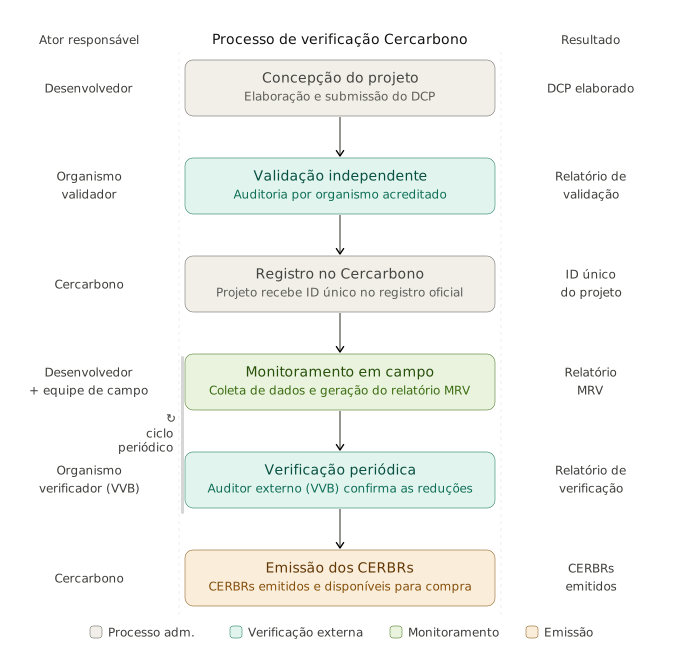
The MRV lifecycle underpins the credibility of every credit. During the measurement stage, recognized field and remote sensing methodologies quantify carbon stock changes and avoided deforestation. These findings are compiled into comprehensive Project Design Documents and monitoring reports detailing activity data, emission factors, and calculation models. Finally, an accredited independent auditor (Designated Operational Entity / Validation and Verification Body) inspects field sites, verifies data fidelity, and audits methodological compliance before credits can be issued on public registries.
Despite rigorous protocols, project developers must actively manage structural risks. Non-permanence risk refers to potential carbon stock reversals from wildfires or illegal logging, traditionally mitigated through buffer pools—a reserve percentage of credits withheld from market circulation. Leakage occurs when deforestation pressure shifts outside project boundaries, requiring regional monitoring and community livelihood incentives. Double counting involves claims where a single reduction is claimed by multiple parties, a challenge addressed through centralized digital registries and Article 6 corresponding adjustments under the Paris Agreement. These considerations do not undermine market value; rather, they emphasize the vital importance of partnering with verified, high-integrity projects.
The projects developed by Canopée follow this technical and structured approach. Certification is conducted under the Cercarbono standard, which establishes methodologies applicable to the Brazilian context and requires the complete application of the MRV cycle, including validation and verification by independent entities.
While environmental quantification involves inherent ecological variables, combining conservative methodologies, accredited third-party audits, buffer reserves, and public digital registries ensures that carbon credits represent genuine, verifiable climate impact aligned with best international practices.