CORSIA: Why Not Every Carbon Credit Works for Aviation
From 2027, the mechanism ceases to be voluntary for countries. Understanding what separates a common credit from an aviation-eligible credit has become a practical issue for buyers and developers.
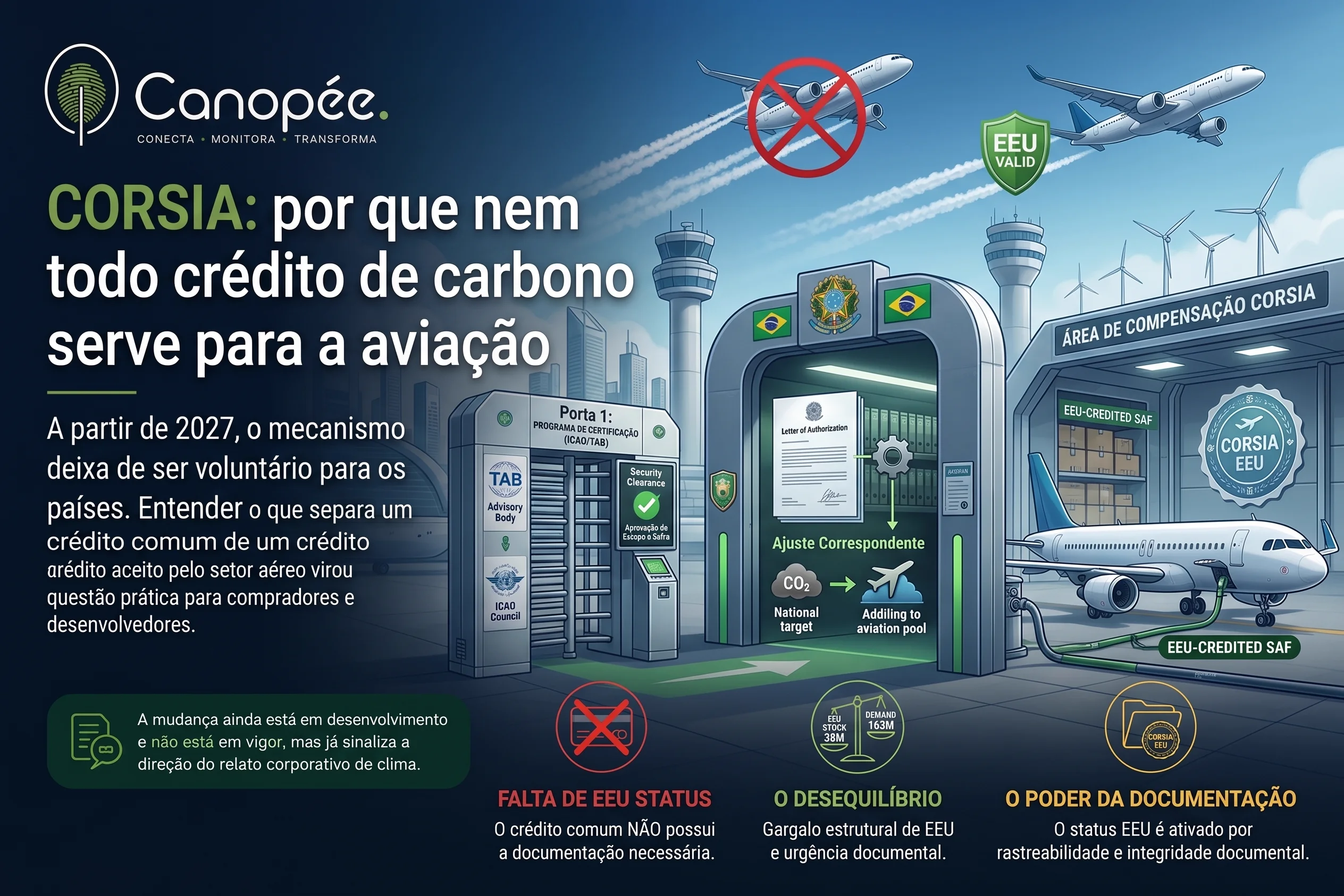
CORSIA is the International Civil Aviation Organization's (ICAO) global market-based measure to offset emissions exceeding a 2019 baseline. Covering approximately 60% of international aviation emissions, it is poised to become the largest single source of compliance demand for carbon credits. Phase 1 covers emissions from 2024 through 2026, with airlines required to retire eligible units by January 31, 2028. Brazil has joined the group of nations incorporating mandatory compliance from 2027, alongside the European Union, Japan, and Canada. However, a distinction still generates confusion across the market: a valid carbon credit is not automatically accepted by CORSIA.
An approved unit receives the technical designation of EEU (Eligible Emissions Unit). It is crucial to emphasize this point because it is counterintuitive: an EEU is not a distinct project type; it is a regulatory status. The same REDD+ credit registered today may or may not hold this status, and the difference lies entirely in the documented legal and regulatory approvals attached to it. For this status to exist, two regulatory gates must open simultaneously, governed by different authorities.
The first gate is the standard-setting crediting programme. ICAO maintains an independent panel called the Technical Advisory Body (TAB), which assesses standards applying to supply units, evaluating governance, additionality, permanence, environmental and social safeguards, and the prevention of double counting. TAB does not issue credits; it recommends programmes, with final approval granted by the ICAO Council. Crucially, approval is never generic: it applies strictly to specific methodologies and credit vintages.
The second gate belongs to the host country government. The project requires a formal Letter of Authorization issued by the host government—in Brazil, the federal government—accompanied by a Corresponding Adjustment. The adjustment is the accounting mechanism by which the host nation acknowledges that the emission reduction has been transferred internationally and deducts that volume from its own Nationally Determined Contribution (NDC) target, preventing the same tonne from being counted twice. Certain programmes admit an interim alternative where qualified insurance temporarily guarantees the adjustment. That alternative warrants close reading: it protects the airline, but shifts the risk to the seller, who assumes the contractual obligation to replace the units if the authorization is never granted.
The supply-demand imbalance explains why CORSIA has become pressing. Estimated demand for Phase 1 reaches approximately 163 million units, while current qualifying supply stands around 38 million—roughly 23% of requirements. New issuances and authorizations should narrow this deficit, but the structural bottleneck depends on sovereign decisions moving at their own pace. For forest carbon developers in Brazil, the practical takeaway is clear: documentation readiness must precede market entry. At Canopée, we treat traceability and documentation integrity as core product attributes, because that layer ultimately determines which compliance markets a credit can access.