Carbon Market in Q3 2026: Fewer Credits, More Value
Transaction value grew 11% despite a 9% drop in retirements, driven by the increasing value of high-quality credits.
The voluntary carbon market closed the third quarter of 2026 with a clear message: companies are buying fewer credits, but paying more for each one. That is the finding of Sylvera’s quarterly report. Sylvera is one of the world’s leading carbon credit rating agencies.
In this article, we explain the key figures and what they mean for companies that buy or are considering buying carbon credits.
The quarter in numbers
First, an essential concept: to "retire" a credit means to use it permanently to offset an emission. Once retired, a credit cannot be sold or used again. That is why credit retirements are the best measure of the market’s actual demand.
| Indicator | Q3 2026 | Q3 2025 |
|---|---|---|
| Credits retired | 30.6 million | 33.7 million |
| Value transacted | US$211.8 million | US$190.6 million |
| Average price per credit | US$6.92 | US$5.66 |
Volume fell by 9%, but the value transacted rose by 11%. The reason was the average price, which increased by 22% in one year. From January to September, the market transacted US$798 million, 14% more than in the same period in 2025.
Why prices rose: quality is worth more
Not all carbon credits are the same. Independent agencies assess each project and assign it a quality rating, similar to risk ratings in financial markets. The higher the rating, the greater the confidence that the credit represents a real climate benefit.
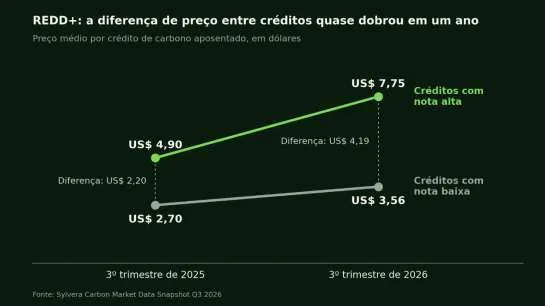
The report shows that this rating has an increasing influence on price. The clearest example is REDD+ credits, generated by projects that prevent forest deforestation:
- High-rated credits rose from US$4.90 to US$7.75 in one year, an increase of 58%.
- Low-rated credits rose from US$2.70 to US$3.56.
- The price gap between the two groups nearly doubled, from US$2.20 to US$4.19.
The same pattern can be seen in reforestation projects, where highly rated credits are worth almost twice as much as other credits.
Supply is also improving. Among newly issued credits in 2026, the share with high ratings rose from 28% to 43%, while the share with the lowest rating fell from 25% to 5%.
Who is buying?
The buyer profile is changing. Large oil companies, which led purchases for years, have lost ground. Shell, for example, retired about 496,000 credits in 2026, compared with 7 million in the same period last year.
Meanwhile, other sectors have gained importance:
- Banks, asset managers and professional services firms divide their purchases between renewable energy and REDD+, with about one-third allocated to each.
- Healthcare and consumer goods companies prefer forestry credits.
- Transport and logistics companies concentrate their purchases in renewable energy.
REDD+ credits accounted for 18% of retirements in the quarter, with projects from a wider range of countries, including Brazil, Colombia, Peru and Cambodia.
One point to watch: renewable energy credits are still the most widely used, accounting for 41% of the total, even though they receive the lowest quality ratings. In other words, the market values quality but still consumes a large number of low-cost credits.
What this means for your company
For companies buying carbon credits, the report offers three practical lessons:
- A low price does not necessarily mean a good deal. Very cheap credits tend to be lower quality and may expose a company to questions about the credibility of its offsetting.
- It is worth understanding where a credit comes from. Buyers should ask where the project is located, who certified it, which methodology was used and how the results are verified.
- Waiting is becoming more expensive. As prices for higher-quality credits rise, postponing a decision is likely to cost more.
It is worth remembering that carbon credits are the final step in a climate strategy. Before offsetting, a company needs to measure its emissions and reduce them wherever possible.
A more mature market
The quarterly data point to a more selective market, where transparency and quality matter more than volume. For those taking the climate agenda seriously, that is good news.
At Canopée, we develop forest conservation projects in the Amazon and help companies measure their greenhouse gas emissions. If your company wants to understand where to start, speak with our team.
Source: Sylvera Carbon Market Data Snapshot Q3 2026, published on October 5, 2026. Canopée calculated the percentage changes in volume, value and price using figures from the report.